Chapter 1: Indus Valley & Bronze Age Civilizations
1. Proto-Historic Chronology & Spatial Horizon
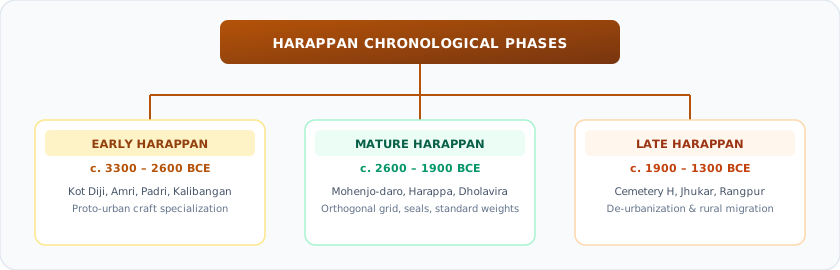
The Indus Valley Civilization (IVC), or the Harappan Civilization, flourished across the Indus and Ghaggar-Hakra river basins during the Bronze Age (c. 2600 BCE – 1900 BCE for the Mature Phase). Encompassing over 1.3 million square kilometers across modern India, Pakistan, and Afghanistan, it constituted the most spatially extensive civilization of the third millennium BCE.
Key Geographical Anchor Sites
| Site | Location & River Basin | Key Excavator | Signature Discoveries |
|---|---|---|---|
| Harappa | Montgomery (Punjab, Pakistan), Ravi | Daya Ram Sahni (1921) | Granaries, Workmen's quarters, Vanity case, Stone lingam, Copper scale |
| Mohenjo-daro | Larkana (Sindh, Pakistan), Indus | R.D. Banerji (1922) | Great Bath, Great Granary, Bronze Dancing Girl, Steatite Bearded Priest, Pashupati Seal |
| Dholavira | Kutch (Gujarat), Luni/Rann | R.S. Bisht (1990) | Tripartite city layout, Massive stone reservoirs, Cascading water harvesting, 10-character Signboard |
| Lothal | Ahmedabad (Gujarat), Bhogava | S.R. Rao (1954) | Tidal dockyard, Bead factory, Persian Gulf seal, Joint double burial, Rice husk traces |
| Kalibangan | Hanumangarh (Rajasthan), Ghaggar | B.B. Lal & A.K. Ghosh | Ploughed agricultural field, Fire altars (agnikundas), Camel bones, Wood furrowing |
| Rakhigarhi | Hisar (Haryana), Drishadvati/Ghaggar | Amarendra Nath / Vasant Shinde | Largest Harappan site (~350 ha), DNA paleogenomics, Granary complex, Lapidary workshop |
| Chanhu-daro | Sindh, Pakistan, Indus | N.G. Majumdar & E.J.H. Mackay | City without a Citadel, Bead-making factory, Inkpot trace, Dog paw footprint on brick |
| Shortugai | Badakhshan (Afghanistan), Oxus | H.-P. Francfort | Northernmost trading outpost for Lapis Lazuli procurement, Canal irrigation system |
2. Advanced Urban Planning & Hydraulic Engineering
The Orthogonal Grid & Standardized Masonry
Harappan urban centers were characterized by a sophisticated orthogonal grid layout (Hippodamian scheme), with principal avenues aligned strictly North-South and East-West, intersecting at precise 90-degree angles.
- Citadel vs. Lower Town: Most settlements were divided into an elevated western Citadel (acropolis) on mud-brick platforms (housing administrative and ceremonial structures) and a larger, lower eastern residential sector.
- Standardized Metrology: Fired and sun-dried bricks followed an empire-wide standardized dimensional ratio of
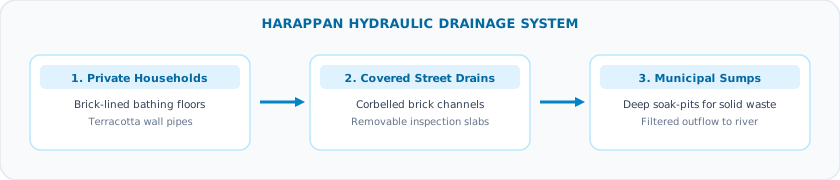
(thickness : breadth : length, typically ). - Hydraulic Mastery: Mohenjo-daro had over 700 brick-lined circular wells. The Great Bath featured gypsum-bitumen mortar waterproofing, corbelled drains, and an elaborate supply/drainage infrastructure.
::: pitfall Common Exam Pitfall Do not confuse Dholavira with standard two-part Harappan layouts. Dholavira is uniquely divided into three segments: Citadel (Castle & Bailey), Middle Town, and Lower Town, and made extensive use of dressed stone masonry rather than mud-bricks. :::
3. Economy, Maritime Trade Networks & Metallurgy
Trans-Continental Trade (Mesopotamia, Dilmun, Magan)
Cuneiform inscriptions of Sargon of Akkad (c. 2334–2279 BCE) document maritime trade with three eastern lands:
- Dilmun: Identified as Bahrain (Persian Gulf trans-shipment hub).
- Magan (Makkan): Identified as the Oman Peninsula (rich source of copper).
- Meluhha: The Harappan Civilization (source of carnelian, lapis lazuli, timber, sesame oil, and ivory).
::: theorem Metrological Uniformity Harappan trade was facilitated by cubical chert weights following a dual system: binary in smaller units (
4. Harappan Script & Religious Ideology
- The Script: Undeciphered, logo-syllabic, written primarily right-to-left (Boustrophedon in multi-line inscriptions). The longest text contains only 26 symbols (Dholavira Signboard).
- Religious Manifestations:
- Proto-Shiva / Pashupati Seal: Three-faced seated figure in yogic posture flanked by four beasts (Elephant, Tiger, Rhinoceros, Buffalo) and two Antelopes below.
- Mother Goddess Terracottas: Fertility cult figurines with fan-shaped headdresses.
- Aniconic worship: Lingas, yoni rings, pipal tree (Ficus religiosa) veneration, and humped bull reverence.
5. Historiographical Debate: The Decline of the Harappans
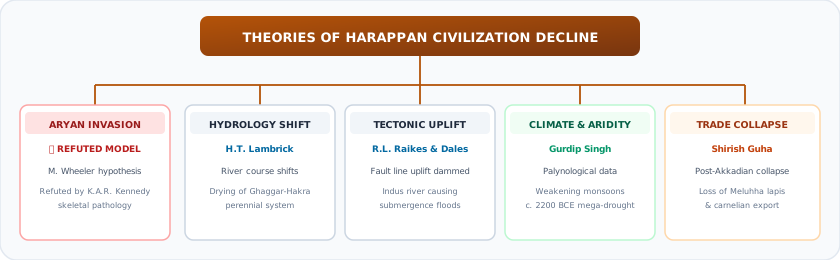
- Aryan Invasion Hypothesis (Discarded): Wheeler cited Rigvedic references to Indra as Purandara (fort-destroyer) and unburied skeletons at Mohenjo-daro. Critiqued by George Dales and K.A.R. Kennedy (skeletal trauma shows erosion/malaria, not battle slaughter).
- Ecological and Climate Desiccation: Palynological studies (Gurdip Singh) prove weakening of the South Asian Monsoon ~2200 BCE, leading to drought and de-urbanization into the Gangetic valley.
- River Course Shifting: Tectonic activity diverted the Yamuna and Sutlej into the Ganga and Indus respectively, desiccating the Ghaggar-Hakra perennial river system.
Check Your Mastery
⚡ Concept Quick-CheckTest Your Conceptual Intuition
Which of the following sites exhibits the unique urban tripartite division (Citadel, Middle Town, and Lower Town) along with a monumental stone water reservoir system?