Chapter 1: British Colonial Expansion, Land Settlements & Economic Drain
1. The Tripartite Colonial Land Revenue Settlements
To guarantee predictable agrarian extraction to fund British imperial wars and mercantile remittances, the East India Company instituted three distinct land revenue regimes across India:
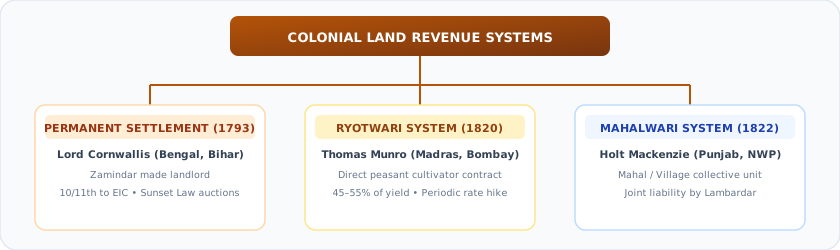
Institutional Mechanics Comparison
| Revenue System | Coverage Area | Primary Tax Intermediary | Revenue Assessment Basis | Sunset Law Provision |
|---|---|---|---|---|
| Permanent Settlement (1793) | ~19% of British India (Bengal, Bihar, Odisha, Northern Circars) | Zamindar (Recognized as hereditary proprietor) | Revenue fixed perpetually at | Strictly Enforced (Failure to pay by sunset on due date led to auction of estate) |
| Ryotwari System (1820) | ~51% of British India (Madras, Bombay, Assam, Coorg) | Ryot (Individual peasant cultivator) | Assessed on estimated soil fertility; set between 45%–55% of gross produce; revised every 30 years | Peasant evicted upon non-payment; coercive state collection |
| Mahalwari System (1822) | ~30% of British India (Gangetic Valley, Punjab, Central Provinces) | Lambardar / Village Headman representing the Mahal | Joint and several liability of the whole village community; revised periodically | Collective forfeiture of village land rights |
2. De-Industrialization & Commercialization of Agriculture
- De-Industrialization Thesis: As analyzed by Amiya Kumar Bagchi and Bipan Chandra, one-way free trade tariffs imposed by Britain flooded Indian markets with machine-made Lancashire textiles, destroying urban artisanal centers (Dhaka muslin, Murshidabad silk) and forcing millions of weavers into overburdened rural farming.
- Forced Commercialization: Coercive cultivation of export cash crops (Indigo, Opium, Cotton, Jute) reduced land under food grains, triggering devastating famines (Bengal Famine of 1770, Great Famine of 1876–78).
3. Dadabhai Naoroji & The Drain of Wealth Theory
In his seminal work Poverty and Un-British Rule in India (1901), Dadabhai Naoroji (The Grand Old Man of India) mathematically established that a substantial portion of India’s national wealth was unrequitedly drained to Britain without any economic return.
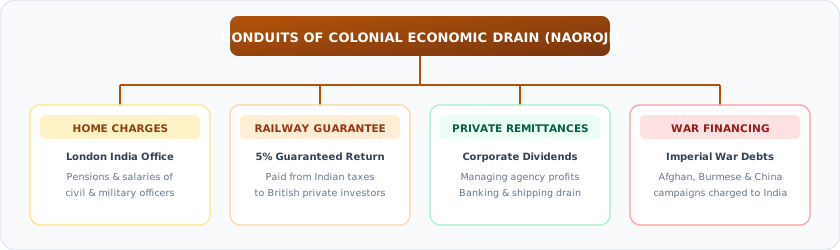
::: theorem Naoroji's Drain Equation
Economist R.C. Dutt in Economic History of India stated: "Taxation raised by a king is like the moisture sucked by the sun, to be returned as fertilizing rain; but the moisture raised from the Indian soil now descends as fertilizing rain on England." :::
Check Your Mastery
⚡ Concept Quick-CheckTest Your Conceptual Intuition
Who was the nationalist leader and author of 'Poverty and Un-British Rule in India' who first propounded the 'Drain of Wealth' theory in 1867?