Chapter 3: Rise of Modern Nationalism, Moderates vs. Extremists & Swadeshi
1. Foundation of the Indian National Congress (1885)
Formed in Bombay on December 28, 1885, at Gokuldas Tejpal Sanskrit College under the presidency of Womesh Chandra Bonnerjee, attended by 72 delegates:
- Allan Octavian Hume (A.O. Hume): Retired British civil servant who facilitated the formation.
- Historiographical Debate:
- Safety-Valve Theory (Lala Lajpat Rai, R.P. Dutt): Hume organized the Congress under Viceroy Dufferin’s guidance to forestall another violent uprising.
- Lightning-Conductor Theory (Gopal Krishna Gokhale, Bipan Chandra): Early Indian nationalists used Hume as a protective lightning conductor to avoid instant government suppression.
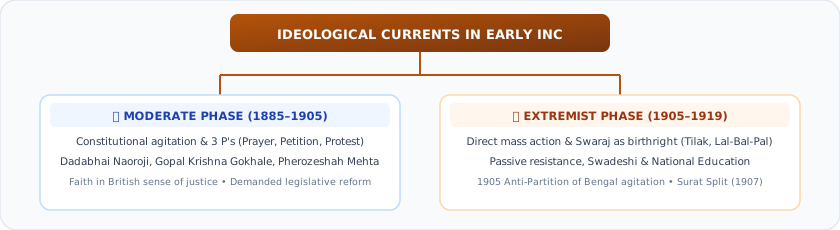
2. Partition of Bengal (1905) & The Swadeshi Movement
On October 16, 1905, Viceroy Lord Curzon partitioned Bengal into Western Bengal and Eastern Bengal & Assam under the pretext of administrative convenience, but with the explicit political objective of dividing the Bengali nationalist intelligentsia along Hindu-Muslim communal lines.
Forms of Swadeshi Agitation
- Boycott of Foreign Goods: Public bonfires of Manchester cloth and Liverpool salt.
- National Education: Establishment of the National Council of Education (1906) and Bengal National College under Aurobindo Ghosh.
- Samitis: Volunteer corps (e.g., Swadesh Bandhab Samiti of Ashwini Kumar Dutta) mobilized mass support.
- Cultural Resurgence: Rabindranath Tagore composed Amar Sonar Bangla and led mass Raksha Bandhan rituals on the streets of Calcutta.
3. The Surat Split (1907) & Morley-Minto Reforms (1909)
- Surat Split (December 1907): Clash between Moderates (led by Rash Behari Ghosh and Pherozeshah Mehta) and Extremists (Tilak, Lal, Pal) over resolutions on Swadeshi, Boycott, and National Education resulted in the expulsion of Extremists.
- Indian Councils Act 1909 (Morley-Minto Reforms): Introduced Separate Electorates for Muslims, institutionalizing statutory communal representation in Indian politics.
Check Your Mastery
⚡ Concept Quick-CheckTest Your Conceptual Intuition
Which colonial constitutional enactment first introduced separate statutory communal electorates for Muslims in British India?